National Steel Bridge Alliance
In This Section
Resources for Contractors
 Cost savings. Constructibility. Efficient timelines.
Designed to help contractors make informed decisions and streamline the bidding process, these practical tools and reference materials feature relevant links, visual aids, and detailed guidance, offering insights that highlight the advantages of steel solutions.
Pre-Construction Phase
Develop comprehensive project plans, identify risks, and carefully coordinate between teams in the pre-construction phase to help facilitate smoother execution, cost efficiency, for improved project outcomes. Give contractors a head start by clearly defining all aspects of material availability, cost estimation, and construction timelines during the pre-construction phase using the NSBA resources for these key considerations.
Know your plates and shapes: Smarter project cost estimation
Steel is available! Several producers provide a wide variety of plate sizes in various grades, thicknesses, widths, and lengths. Knowing which plate sizes are made by each domestic plate mill can help you better understand material costs.
To start your research, consult "Steel Plate Availability for Highway Bridges," published in Modern Steel Construction, where you'll find several tables showing maximum plate-length availability for various widths, thicknesses, and grades of steel from up to three domestic plate mills. The article also discusses the nesting of flanges and how girder webs with camber are cut from these plates.
You can also check which domestic shape mills produce the shapes that are often used for cross-frames and various secondary members using the AISC shape search tool. Input the desired shape, weight, and grades, and find out which mills produce the shapes you're looking for.
To get started, read AASHTO/NSBA Steel Bridge Collaboration G12.1-2020 Guidelines to Design for Constructability and Fabrication Section 1.4.
Speed Up Fabrication
Confirm that all aspects of fabrication align with the project schedule and construction goals using NSBA's Accelerated Steel: Achieving Speed in Steel Bridge Fabrication, which outlines how to coordinate with fabricators, owners, and engineers, offering key insights that can streamline the steel fabrication process. Implement the practices outlined in this guide for efficient, coordinated, and timely steel fabrication processes to improve project outcomes and, ultimately, boost profitability.
Reduce construction time
Does your steel bridge project have a need for speed? Reduce construction times using the following methods:
- Design/build (progressive D/B) contracts: Encourage faster decision-making/flexibility.
- Bridge prefabrication: Reduce time spent on-site.
- Incremental launching: Allow for continuous bridge construction.
- Use prefabricated deck panels: Speed up deck installation.
To learn more about these strategies for speeding up steel bridge construction, consult NSBA's Reducing Time for Steel Bridge Construction.
Choose a corrosion protection system
Below is a chart that indicates the relative percent cost increase of various steel bridge corrosion protection systems with uncoated weathering steel (UWS) as the baseline. This information is general in nature and may not apply to all bridge spans. NSBA recommends reaching out to a local fabricator for more accurate relative cost information.
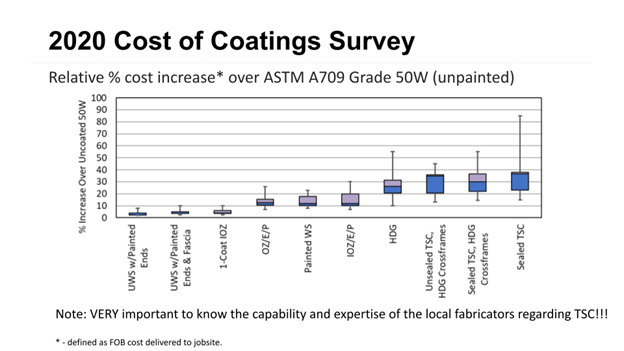
Enhance efficiency and reduce fabrication shop time by choosing the appropriate corrosion protection system that will meet the anticipated exposure needs of the specific project.
- Uncoated weathering steel (UWS): UWS is the preferred corrosion protection system as it does not require any applied coating applications, reducing time in the fabrication shop and, therefore, reducing overall initial and life-cycle project costs. NSBA’s Uncoated Weathering Steel Reference Guide provides information on the appropriate use of UWS for a given bridge subjected to certain micro and macro environments, along with suggested details that can help to provide a long-lasting structure.
- See also: FHWA Weathering Steel Performance Data
- Single-coat inorganic zinc (SIOZ): Used as a primer layer in paint systems for steel structures, inorganic zinc coatings (such as paints) may also be used alone in some situations. Learn more in NSBA's report, Single Coat Inorganic Zinc Protection for Steel Bridges.
- Two-coat paint systems: For a zinc-rich primer followed by a polyaspartic, polysiloxane, or acrylic finish coat, reference AASHTO's Transportation System Preservation Technical Services Program (TSP∙2), as well as NTPEP's Structural Steel Coatings DataMine.
- Three-coat paint systems: These systems consist of a zinc-rich primer, an epoxy mid-coat, and a polyurethane top coat. (Some also use a clear coat on fascia girders for enhanced resistance to ultraviolet light in southern latitudes.) For more, see NSBA’s Steel Bridge Design Handbook, Vol. 19, as well as NTPEP's Structural Steel Coatings DataMine.
- Metallizing/thermal spray coatings (TSC): Pure zinc, pure aluminum, or an alloy of 85% zinc and 15% aluminum comprise the most common coating choices applied to bridge steel substrates. For more, see NSBA’s Steel Bridge Design Handbook, Vol. 19, as well as AASHTO/NSBA Steel Bridge Collaboration Specification for Application of Thermal Spray Coatings.
- Hot-dipped galvanizing (HDG): Dipping steel elements into molten zinc creates a protective layer. For more information, consult Volume 19 of the NSBA Steel Bridge Design Handbook, AASHTO/NSBA Steel Bridge Collaboration Hot-Dip Galvanizing Specification, and the American Galvanizers Association website.
The University of Delaware’s study Durability of Steel Bridge Corrosion Protection Systems, commissioned by AISC, uses advanced lab testing for its report, evaluating how different coatings perform over time and offering valuable insights for engineers focused on long-term performance in harsh environments.
Prepare accurate and competitive bids
To win contracts while maintaining profitability, it all depends on the quality of your bid. Use the following strategies to help refine cost estimates, set realistic timelines, and account for the complexities of steel bridge construction.
Quickly estimate material quantities and costs
Accurate estimates of quantities for material needed lead to more precise cost projections. Use NSBA's Span-to-Weight Charts included in Steel Span to Weight Curves to obtain crucial data on the relationship between span lengths and the weight of steel required, which directly impacts material costs.
Reference tried-and-true designs
Want a straight steel I-girder bridge design, fast? Save time using AISC/NSBA’s Standard Plans for Steel Bridges to access an array of lengths and span arrangements, all designed to optimize design and fabrication for efficiency and cost-effectiveness.
Account for design complexities
Skewed and curved bridges present unique challenges, especially when fitting steel girders. To increase the likelihood of proper alignment and avoid unforeseen cost increases during construction, refer to NSBA’s Skewed and Curved Steel I-Girder Fit Summary for more information and recommended fit conditions.
Design and Engineering
Collaborate with engineers and designers to confirm that you execute the project goals efficiently, using “value engineering” and optimal corrosion protection strategies to enhance durability and cost-effectiveness. Get a head start on this phase with the following resources.
Design collaboratively
Bridge designers and engineers can align on project specifications, budget, and timelines by involving contractors early in this phase. Doing so offers contractors the opportunity to provide practical insights on constructability and identify potential challenges before they arise on-site.
For recommendations for designing straight bridges with little or no skew, NSBA’s design guide, Navigating Routine Steel Bridge Design, features a series of hyperlinked checklists that walk engineers and designers step-by-step through the process, focusing on the specific provisions of the AASHTO LRFD Bridge Design Specifications that apply to routine bridges.
Consider value engineering solutions…
Value engineering lets contractors collaborate with designers on alternative construction methods, material selections, and streamlined processes. Consider the following resources for potential value engineering solutions:
...by bridge type
- The AISC/NSBA Standard Plans for Steel Bridges can be used to quickly assess a proposed design and compare the material requirements, constructability, and cost-effectiveness.
- A notable feature of the I-91 Interchange 29 exit ramp flyover bridge is the three-I girder steel bent cap, which reduced fabrication and shipping costs while providing load path redundancy, demonstrating how thoughtful design and engineering can lead to cost savings during construction, as well as long-term savings in reduced fracture-critical inspections.
- Press-brake-formed tub girders (PBFTGs) offer a lightweight, cost-effective solution, helping to minimize fabrication time and reduce the overall project cost, plus a longer service life than other systems used for short- and medium-span bridges.
- Link slabs eliminate expansion joints for a more cost-effective and low-maintenance design. Learn more about these and other common forms of prefabrication in the recorded webinar, Benefits of Steel in Accelerated Bridge Construction.
...by bolting methods
Reduce labor time while improving the integrity of connections by enhancing bolted connections with NSBA Splice, which takes the task of designing and checking a bolted splice connection and rewrites the process with a simple input page and output form. Plus, it helps the designer quickly analyze various bolted splice connections on plate girder bridges to determine the most efficient bolt quantity and configuration.
...by lean-on bracing
Reducing the number and complexity of cross frames—one of the costliest elements in a steel bridge, on a dollars-per-pound basis—can significantly impact the speed of both fabrication and erection, as well as overall bridge cost. Refer to NSBA’s Lean-on Bracing Reference Guide for ways to potentially eliminate at least 50% of the full cross-frames required for a routine steel I-girder bridge without adding any cost to the girders.
Construction Phase
For bridge contractors, any missteps during the construction phase can lead to costly delays or compromises in quality, directly affecting project timelines, budgets, and ultimately the project's success. Consider the following factors for maintaining efficiency, ensuring safety, and delivering a high-quality bridge.
Mobilize the project
Mobilize to provide a seamless transition, from planning to execution, in the first step of the construction phase by effectively organizing deployments of resources, equipment, and personnel to the construction site.
- Make a plan for mobilizing resources and personnel: Determine the optimal location for equipment, arrange workforce schedules, and verify all materials are ordered and delivered on time to prevent delays.
- Optimize the setup of on-site facilities: Locate on-site facilities to streamline operations, with areas dedicated to material storage, crew accommodations, and equipment staging.
- Handle materials with care: Handling construction materials properly maintains their integrity and prevents damage. For instance, check out this AASHTO/NSBA collaboration document, G4.2-2024 Guidelines for the Qualification of Structural Bolting Inspectors, to learn how proper bolt storage will help maintain the longevity of bolts long after construction is completed.
Apply advanced construction methods
Significantly reduce construction time, improve efficiency, and minimize risks associated with bridge projects using advanced construction methods:
- Accelerated Bridge Construction (ABC): Reduce on-site construction time and minimize the impact on traffic, consider ABC methods like slide-in bridge construction, prefabricated bridge elements, self-propelled modular transporters (SPMTs), and longitudinal launching. For a comprehensive guide, refer to the FHWA ABC Manual.
- Prefabricated Bridge Elements and Systems (PBES): Minimize the project duration and enhance quality control with prefabricated components assembled off-site to save time and reduce on-site labor.
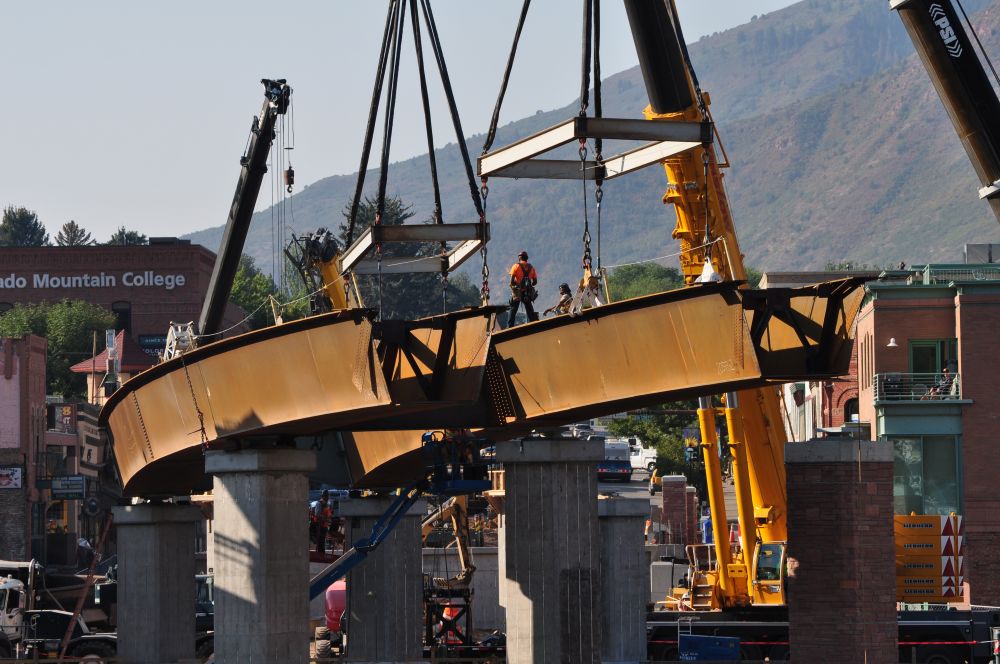
- Structural placement methods: Depending on the site and project scope, contractors may use advanced techniques such as SPMTs and longitudinal launching (see ABC techniques, above), or even conventional heavy-lifting equipment to place large bridge elements efficiently.
Plan project schedules around constructability
Efficient construction avoids delays and keeps costs in check. For example, proper planning for crane access and the erection sequence can significantly reduce onsite issues. Account for terrain, crane size, and other logistical challenges to confirm that large components can be safely erected without impacting the overall project timeline. Learn more from the bridge erection perspective.
Manage project schedules efficiently
Minimize delays and keep the project within its timeline and budget by anticipating potential obstacles and planning contingencies to maintain momentum.
- Effective project scheduling: Apply advanced scheduling tools and techniques to break the project into manageable milestones, ensuring that each phase is completed on time and aligns with the overall project goals.
- Minimizing delays: Identify potential risks early, including weather, material shortages, and labor availability, then incorporate buffer time wherever necessary to keep the project on track. For further guidance, refer to NSBA's Reducing Time for Steel Bridge Construction.