National Steel Bridge Alliance
Corrosion Protection and Durability Resources
There are several proven ways to protect steel bridges from corrosion, and no single solution is best for all circumstances.
The first consideration when selecting one of these techniques is, of course, a bridge’s anticipated exposure to corrosive elements over its lifetime. In addition, teams must consider initial and life-cycle costs, fabrication, productivity, and long-term performance and maintenance when choosing a corrosion protection approach for a given bridge.
General resources:
- Volume 19 of The NSBA Steel Bridge Design Handbook focuses on corrosion protection.
- AASHTO's National Transportation Product Evaluation Program (NTPEP) offers a wealth of information about various structural steel coatings.
- The Society for Protective Coatings (SSPC) issues and maintains many coating standards, including the SSPC Good Painting Practice and Systems and Specifications Manuals. Both the SSPC and the National Association of Corrosion Engineers (NACE) provide training and certification for coatings inspectors as well as coating contractors. These certifications help establish a quality threshold for the coatings industry.
- AASHTO/NSBA Steel Bridge Collaboration Guide Specification for Application of Coating Systems (S8.1-2014/SSPC-PA Guide 13).
- Durability of Steel Bridge Corrosion Protection Systems Using Environment-Based Accelerated Corrosion Testing. This study was to evaluate the performance of five of the most common corrosion protection systems used in steel bridges: uncoated weathering steel (UWS), galvanizing, metallizing, 1-coat inorganic zinc paint, and a 3-coat organic zinc paint system, in relatively corrosive environments. The premise of this scope was that UWS is the preferred material type in most environments; but in relatively severe environments, alternative corrosion protection systems may provide benefits in terms of both corrosion protection and life cycle cost.
Some corrosion protection options:
Uncoated weathering steel (UWS) is a widely used corrosion protection system today and performs well if detailed properly and used in the proper location and environment.
UWS bridges employ a high-strength, low-alloy steel that forms a tightly adhering “patina”—essentially an oxide film of corrosion by-products comparable to the thickness of other corrosion protection systems—during its initial exposure to the elements, which controls the rate at which oxygen can reach the bare steel underneath. The resulting color darkens as the patina forms. Depending on the climate, within two to five years, the steel attains a dark, rich, purple-brown color that blends naturally into the visual tableau of its surrounding environs. Plus, fewer coating systems also make UWS a friendly choice for the environment.
For an easy, attractive way to speed up steel bridge construction while reducing long-term costs and environmental impacts, choose UWS.
For additional information, please refer to:
- Uncoated Weathering Steel Reference Guide: If speed is what you're after, then uncoated weathering steel (UWS) is your best choice! UWS doesn't require any applied coating--that means no time spent literally watching paint dry. NSBA's new Uncoated Weathering Steel Reference Guide is your go-to resource for using UWS in a variety of bridges in a diverse mix of environments.
- Section 3.3 (p 19) of Volume 19 of the NSBA Steel Bridge Design Handbook describes UWS.
- How has WS performed historically?
- Section 4.1.1 (p 23) of Volume 19 of the NSBA Steel Bridge Design Handbook
- Connecticut Department of Transportation Study of the Corrosion Performance of Weathering Steel Bridges (May 2021): Uncoated weathering steel has been used in Connecticut for over 50 years. These structures often have both long-term and short-term cost effectiveness as they do not require initial painting, nor is repainting needed throughout the service life. This report reviews the current state of practice for the implementation of weathering steel bridges in the state of Connecticut followed by a review of a large group of weathering steel bridges in the state.
- McConnell, J.; Mertz, D.R.; and Shenton, H.W. III. (2014, September). Time Tested: A look at the performance of the national uncoated weathering steel bridge inventory. Modern Steel Construction. Retrieved from aisc.org/globalassets/modern-steel/archives/2014/09/2014v09_time.pdf.
A note about tunnel-like conditions:
- The FHWA encourages designers to use weathering steel cautiously in "tunnel-like" conditions of grade separation with certain geometric traits and is currently evaluating tunnel-like conditions using computational fluid dynamics models.
- As an example of how one state addresses tunnel-like conditions while still using UWS, the state of Ohio defines tunnel-like conditions as bridges over interstates or four-lane divided highways with speed limits of 55 mph or more and with vertical clearance of 20 feet or less and ADTT of 10% or more. For more information, consult the ODOT Bridge Manual Section 308.2.2.1.d.1.
One-coat inorganic zinc (IOZ) is a relatively thin silicate coating that has performed well in marine atmospheric conditions.
-
SIOZ as the sole durability system is gaining popularity. NSBA conducted a synthesis study with Modjeski and Masters, and this system is showing promising results. Additional guidance is forthcoming, but the report Single Coat Inorganic Zinc Protection for Steel Bridges summarizes the results of the synthesis study.
-
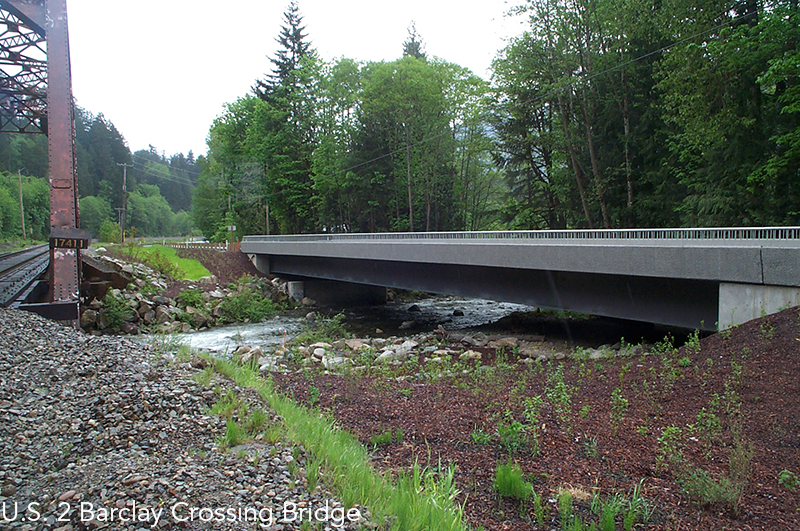
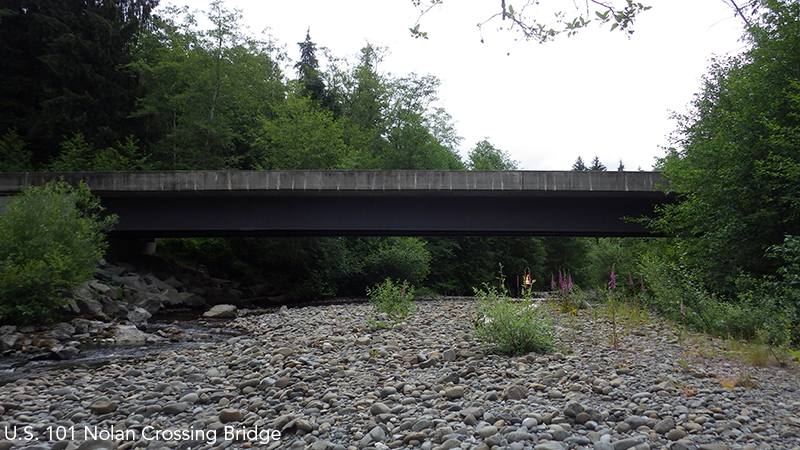
The Washington State DOT constructed two bridges in the early 2000s with only IOZ primer; an organic zinc primer was also applied to bolted connections in the field. The IOZ primer on both bridges are performing well and the bolts/connections are also in good condition.
-
- US2 Barclay: 50 miles east of Everett, WA.
- Nolan Creek: 21 miles south of Forks, WA.
Two-coat paint systems consist of a zinc-rich primer followed by a polyaspartic, polysiloxane, or acrylic finish coat.
- NTPEP's Structural Steel Coatings DataMine is a valuable resource.
- AASHTO's Transportation System Preservation Technical Services Program (TSP∙2) guide to removing and replacing bridge coatings.
- Polyaspartic Coatings article by Ahren Olson, Todd Williams, and Ronnie Medlock, PE.
Three-coat paint systems are a common coating system used to protect steel bridges. Traditionally, these systems consist of a zinc-rich primer followed by an epoxy mid-coat and a polyurethane top coat. Sometimes these systems also use a clear coat on fascia girders for enhanced resistance to ultraviolet light in southern latitudes.
- For a summary of a three-coat system, please see Section 3.1.1 (p 9) of Volume 19 of the NSBA Steel Bridge Design Handbook.
- Section 4.1.3 (p 29) of Volume 19 of the NSBA Steel Bridge Design Handbook details the historical performance of three-coat systems.
- NTPEP's Structural Steel Coatings DataMine is a valuable resource.
- AASHTO's Transportation System Preservation Technical Services Program (TSP∙2) guide to removing and replacing bridge coatings.
Metallizing/thermal spray coatings (TSC) involve a metal coating that is applied to a substrate, like steel. The most common coating choices for bridge steel are pure zinc, pure aluminum, or an alloy of 85% zinc and 15% aluminum.
- For a summary of metalizing, please see Section 3.1.2 (p 12) of Volume 19 of the NSBA Steel Bridge Design Handbook.
- Section 4.1.2 (p 26) of Volume 19 of the NSBA Steel Bridge Design Handbook discusses the historical performance of TSC.
- AASHTO/NSBA Steel Bridge Collaboration Specification for Application of Thermal Spray Coatings (S8.2-2017/SSPC-PA 18).
In hot-dipped galvanizing (HDG), steel elements are dipped into molten zinc to create a protective layer.
- Section 3.2 (p 14) of Volume 19 of the NSBA Steel Bridge Design Handbook summarizes HDG.
- Section 4.1.2 (p 26) of Volume 19 of the NSBA Steel Bridge Design Handbook details the historical performance of HDG.
- The American Galvanizers Association (AGA) provides a large amount of information on galvanizing.
- AASHTO/NSBA Steel bridge Collaboration Hot-Dip Galvanizing Specification (S8.3-2022).
Section 3.4 (p 21) of Volume 19 of the NSBA Steel Bridge Design Handbook summarizes additional corrosion-resistant alloys.