The architects of Boulder, Colo.'s new Fire Station #3 set out to design a 100-year building that would exceed the city's lofty energy conservation goals and serve as a prototype for future fire stations. What they didn't know then was that the project would end up receiving acclaim as a prototype for the concept of circular design and construction. Instead of demolishing a building at the end of its useful life, the building is carefully deconstructed and the materials are reused in new construction, avoiding landfills and reducing embodied carbon.
The 28,300-sq.-ft fire station was in schematic design when the city's project manager approached Denver's Davis Partnership Architects with the idea of reusing structural steel members salvaged during the deconstruction of the 30-year-old decommissioned Boulder Community Hospital in the new fire station. "They said, 'We have this hospital we've been taking down and we have this ordinance that says we have to reuse a certain percentage of those materials. We'd like to use as much of the structural steel as possible on the fire station,'" said Joe Lear, a principal with Davis. "So we started planning to incorporate it into the design."
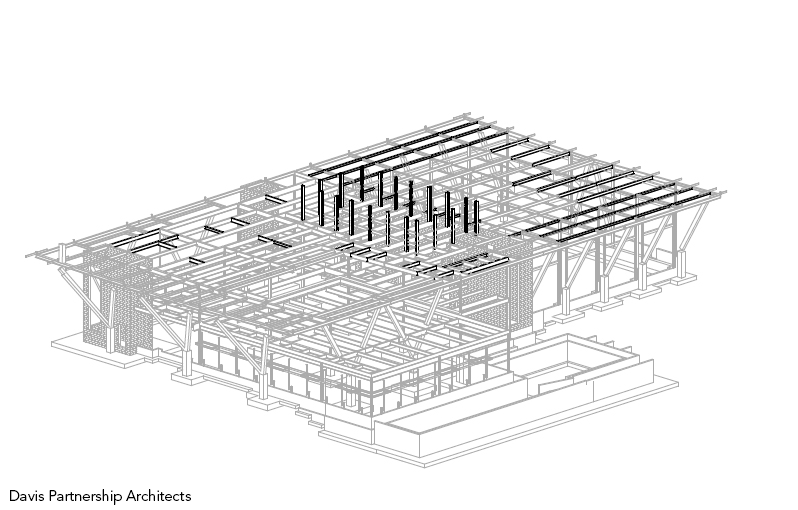
In all, 89 salvaged structural steel members totaling 25 tons were reused in the fire station. In addition to the fire station, 21 other projects have reused members from the 161 tons of structural steel salvaged from the hospital deconstruction, said Lear.
Boulder's deconstruction ordinance, which took effect in 2020 and covers commercial and residential properties, mandates 75% of materials by weight from a deconstruction project must be diverted from a landfill.
In reality, the structural steel from the hospital was in no danger of being landfilled, as 98% of all steel in the U.S. is recovered and put back into the recycling stream to be made into new products, including new structural steel for construction, as a matter of course. But the city wanted to remain true to the spirit of circular construction and seized the opportunity to deconstruct the structural steel components of the hospital instead of recycling the steel to comply with the ordinance and reduce the embodied carbon emissions that would be generated in the process of recycling the steel into new steel products.
"This is a stepping stone for the city toward reaching its long-term goals of achieving zero waste and reducing the city's carbon emissions by 80% by 2050," said Lear. "They've long been a leader in their forward thinking about sustainability, and they've really stepped up and put their money where their mouth is. They're committed to doing this."
As the city and fire department had already approved the design for the fire station when the idea of integrating refabricated salvaged structural steel into the project was introduced, project design proceeded as normal, said Josh Perrin, an architect with Davis. Once the structural design was completed, structural engineer KL&A in Golden, Colo., selected potential members that could be replaced with salvaged members identified in the hospital stockpile catalog. This effort was aided by the fact that KL&A was also a partner with the city in the hospital deconstruction, cataloging, and stockpiling processes for the salvaged structural steel.
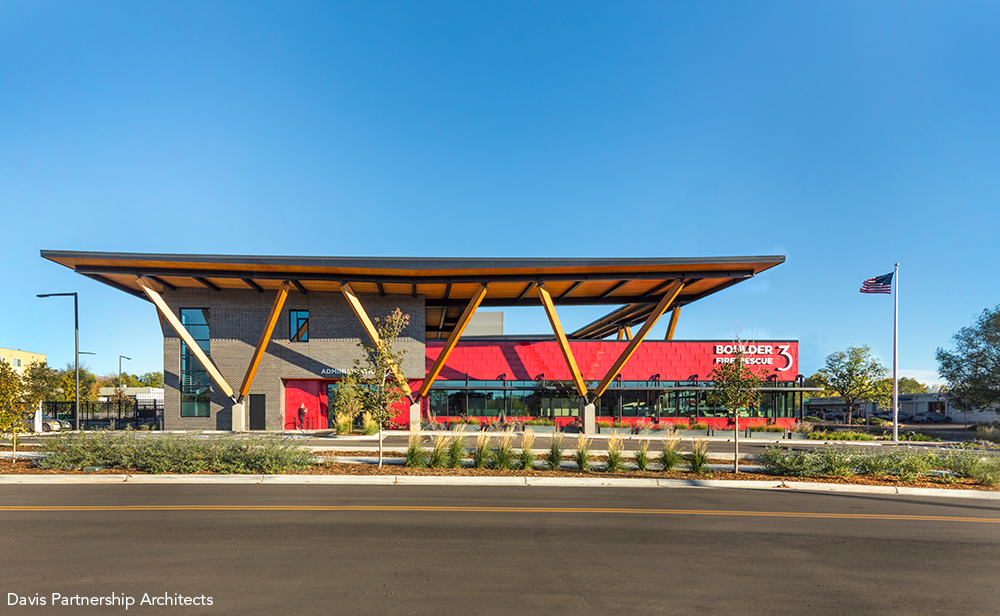
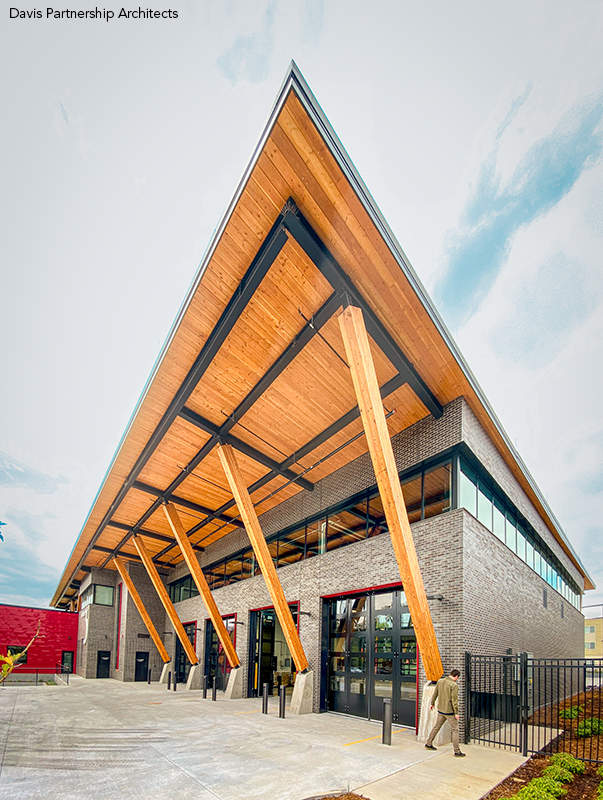 As architects, Davis' role was to guide the process to ensure the replacement members were in keeping with the design intent, said Perrin. He and colleague Animish Kudalkar were responsible for maintaining a consistency and uniformity of look and aesthetics on the interior and exterior of the project, whose hallmark is an oversized exposed structural tongue-in-groove glue-laminated wood roof supported by an exposed structural steel framing system.
The components work gracefully in tandem, making it appear that the roof floats over the building, which comprises the 22,000-sq.-ft fire station and a 6,000-sq.-ft administration building and community room. The exterior is lined with angled glulam columns with steel connections and concrete pilasters that support and complement the roof structure.
The task of ensuring that the salvaged structural steel members were seamlessly integrated into the framing systems with new structural steel members was one that Lear said was more challenging than it may seem. "It wasn't easy," he said, especially in the fire station's four drive-through apparatus bays which house fire, EMS, and water rescue equipment. "In the app bays, we have a lot of exposed structural steel as part of the design. It wouldn't look good if one member is 30 inches deep, and the next is 12 inches deep, and the next is 16 inches deep."
Lear and Perrin credit the success of the steel reuse on the project to the city's steadfast commitment to circular construction as well as KL&A's commitment and involvement in the process, from deconstruction of the hospital and cataloging the structural steel to its incorporation into the structural framing plan. Lear gave kudos to general contractor Mark Young Construction of Frederick, Colo., for figuring out the timing and logistics for everything from tracking the pieces to transporting the members to the steel fabricator for refabrication and getting the packages delivered to the site. "We're really just proud to be a part of the team," said Lear.
What are the prospects for circular design and construction becoming more common?
"I sure hope it's the future," Perrin said, emphasizing that it takes extremely committed clients and cities to fight for the process because there is a premium to carefully deconstructing a building versus demolishing one. The deconstruction cost of the hospital was $9.2 million versus $7.7 million to demolish a similar building, said Perrin. Cities like Boulder also have the capability of creating a marketplace catalog for the stockpile of materials such as salvaged steel available for reuse. A broader marketplace for salvaged structural steel does not currently exist.
While from a financial perspective, the process is fairly neutral, as additional labor costs involved with salvaging the steel meant that savings on material cost was minimal (around $6,000), there is a significant embodied carbon saving, says Perrin. The 89 members reused on the fire station equated to a savings of 25,000 kg CO2eq of embodied carbon.
"Circular construction is an engaging idea," said Lear. "And when you get the entire project team from the owner through the subs onboard, and they embrace it and aren't afraid of it, there's an excitement that's created and they make it successful."
For more on the sustainability of structural steel, visit aisc.org/sustainability.