University Programs
In This Section
Steel Design-Build Grant Program
Four projects are receiving Steel Design-Build Grants for 2025! Find out more.
Have an idea for a design-build project that will expand student engagement with materials? Let us help you bring it to life--with steel!
Faculty members and students with faculty sponsors can propose projects to our Steel Design-Build Grant Program, and AISC will fund one or a handful of them every year. Besides project funds, we want to give architecture students the opportunity to engage with steel--that's why we'll pair them with fabricators who can collaborate at various stages of the project.
Missed our Q&A and application tips webinar? Catch up with the recording!
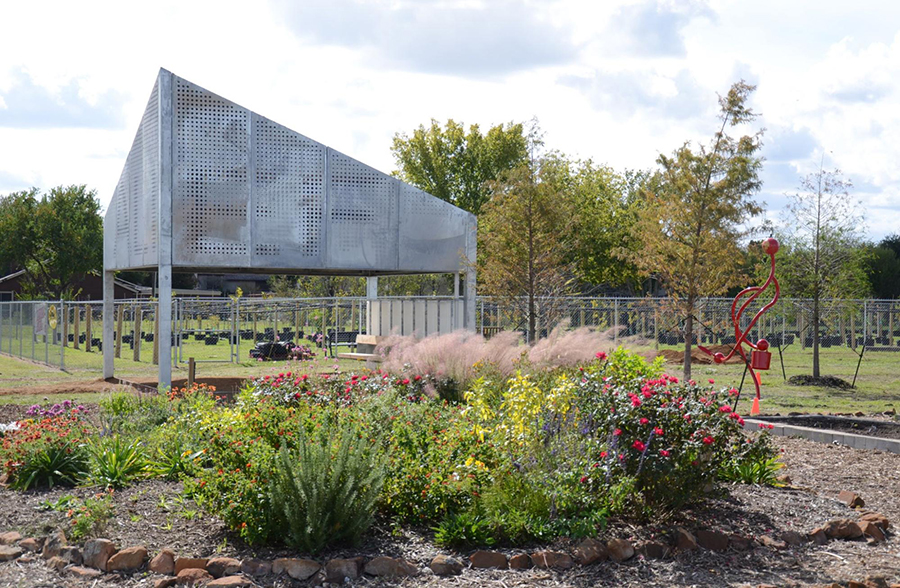
Photo credit: Patrick Peters, University of Houston, Gerald D. Hines College of Architecture Graduate
Design/Build Studio, Alief SPARK Park and Nature Center Solar-powered Outdoor Classroom/
Butterfly Pavilion, 2013.
Grant Program
This grant program, funded by the AISC Education Foundation, provides monetary support for various educational steel-related activities in architecture schools to benefit student learning, including but not limited to full-scale inhabitable builds or built prototypes, furniture, or studies of steel details in precedent buildings. Parameters are flexible to accommodate a wide range of classroom design-build activities and approaches, as well as different scheduling situations.
Don’t know a steel fabricator to partner with? We can help! Just contact us a month before the application is due, and we can put you in touch with a fabricator. We suggest a funding range for each proposal between $10,000 and a maximum of $30,000.
Eligibility
AISC accepts proposals from faculty or students with a faculty sponsor from any architecture program in the U.S.
Schedule
- The deadline for submissions is January 12, 2026. Applicants will be notified by March 6, 2026.
- Grant awards, payouts, and construction deadlines are determined by each applicant and are finalized in collaboration with AISC. These will vary depending on the project and school year schedules, but the project should begin no later than May 2027.
Application Requirements
Please include all of the below items in one PDF, 8½ x 11 portrait orientation. Email the PDF to Jeanne Homer, AIA at [email protected].
Applicants should have the following sections clearly labeled:
- Location: Identify the location of the school and the general site of the project; both should be in the U.S. (100 words max)
- Course/Research: Describe the course(s) and/or research connected to the project (studio, materials, structures, etc.). (100 words max)
- Number of students: Identify how many students will be involved and the number of builds; for example, are there several teams within one class, or one studio build?
- Project information: Provide a project overview--its users, function, scale, site, need for a permit, need for a foundation, etc. (750 words max)
- Use of structural steel: Explain how the project focuses on structural steel, including the use of W-section, angles, channels, HSS, plates, angles, sheets, bolting, and welding. (200 words max)
- Learning objectives: Describe what the students will learn during the design-build project. NAAB learning objectives might be a resource. (200 words)
- Construction: Explain the method of construction. Is it fabricated and erected by students, fabricators, or erectors? How will the students interact with fabricators? (150 words max)
- Facilities: Describe available workshop facilities, equipment, and safety plan, if applicable (500 words max)
Other items to include:
- Constituents: Letters of support outlining a commitment to the project from each of the project’s relevant partners, including clients, engineers, the city, the university, etc. All projects should follow local or university codes and should involve a professional stamp for the project if it is occupiable by users.
- Schedule: Outline or table of a proposed schedule of the project with separate design and building phases, including deliverables for each phase and interactions with AISC, including periodic check-ins. Be sure to identify the appropriate term and year.
- Budget: Outline or table of the proposed budget integrated with the project schedule. Indicate the dates of the requested payouts within the schedule. Note that the earliest payout date in 2026 is May 1. The budget should not include indirect costs and overhead from the university; it is considered an educational project for students. Include the cost for items like student travel to a fabrication shop or similar. Include equipment, rentals, or the cost of finishing the steel with coatings, for example. You may need to consult with your fabricator if applicable. State whether this grant would be your only source of funding, and if not, what your plans are for the remainder of the funding, even if they are not confirmed yet.
- Contingencies: Potential contingencies, such as an unreliable time frame to obtain a building permit.
Judging Criteria
- The potential for structural steel expression
- Spirit of the project--is it community-focused and forward-thinking?
- Consideration of schedule and process logistics--is it reasonable?
- The value to students and AISC
- Consideration of the number of architecture students involved and their involvement in the design, fabrication, and erection of the project
Tips for the application process
- Know your audience. Reviewers may include fabricators and engineers. They typically do not want to read a long introduction or something written in architect-only language.
- Clarity of the application is important. Perhaps invite someone outside your proposal team to review it.
- Students do not have to do extensive hands-on work, but if they are not, there should be a defined plan or approach describing how the interaction with a fabricator would be structured.
- Structural steel is a priority in these reviews. The use of steel shapes and connections, as well as their expression, is desired.
- Propose a project that is pretty well planned. We understand plans can change, but there shouldn’t be major questions unanswered.
- We are looking for architecture students to get direct experience with structural steel, either hands-on or with a fabricator.
Requirements upon award
- Periodic reports and check-ins
- Attendance at NASCC: The Steel Conference with support from the NASCC: The Steel Conference Travel Award: up to $1,500 travel reimbursement for the grant awardee covered by the Education Foundation. The conference for this award cycle will be in Denver, April 14–16, 2027.
- AISC access to photos and AISC permission to use the photos.
If you have questions or concerns about any of the submittals or requirements, please contact Jeanne Homer, AIA at [email protected].
Keep an eye on this space for an announcement of the 2026 jury!
Design-Build Grant Recipients
2025 Recipients
Peter Raab, Huckabee College of Architecture at Texas Tech University
Downtown Arts Gateway in Lubbock, Texas
$20,000
Brian Lee, Kansas State University
Two structural steel pavilions in Manhattan, Kan.
Two $10,000 grants
Armando Araiza, University of Texas at San Antonio
Steel alcove pavilion in San Antonio
$15,000
2024 Recipients
Patrick Peters, the University of Houston's designLAB
Johnson Discovery Classroom in La Marque, Texas
$15,000
To be completed in 2024
Lucas Brown and Daniel Luis Martinez, Indiana University
Bus Stop in Columbus, Indiana
$15,000
To be completed in 2025
Julia Lindgren at the University of Texas, Arlington's Community Design Build Lab
Brookside Bicycle and Pedestrian Rest Stop on the Santa Fe Trail in Dallas, Texas
$30,000
To be completed in 2025