Newsletter Archives and FAQ
Newsletter Archives and FAQ
Newsletter Archives
12/11/25 - Six strategies for specifying sustainable structural steel
11/13/25 - Coming full circle: Davis Partnership Architects on material reuse
10/9/25 - FIFTEEN's Ximena Valle on human-centered design
9/11/25 - 10 questions with Growthitect founder Tyler Suomala
8/14/25 - Five standout buildings to spark your imagination
7/11/25 - Designing a Boston icon on the fly
6/19/25 - Technical question? Let Clark do the heavy lifting for you.
5/8/25 - How did the designers of a Louisville distillery attract international attention?
4/10/25 - New hybrid steel and timber reference will forge the way forward for mass timber
3/12/25 - 'Architecture in Steel' is the odds-on favorite in the Bluegrass State
2/12/25 - Architecture and advocacy
1/16/25 - Matches made in the Hill Country
12/12/24 - Making of a marvel: The Las Vegas Sphere
11/14/24 - Atlanta architects get an up-close look at steelmaking
10/10/24 - Meet the Architecture Center: Your new go-to steel resource
Newsletter FAQ
Find our quick insights and answers to key topics in architecture and design.
December 2025: Column Bay Spacing
QUESTION
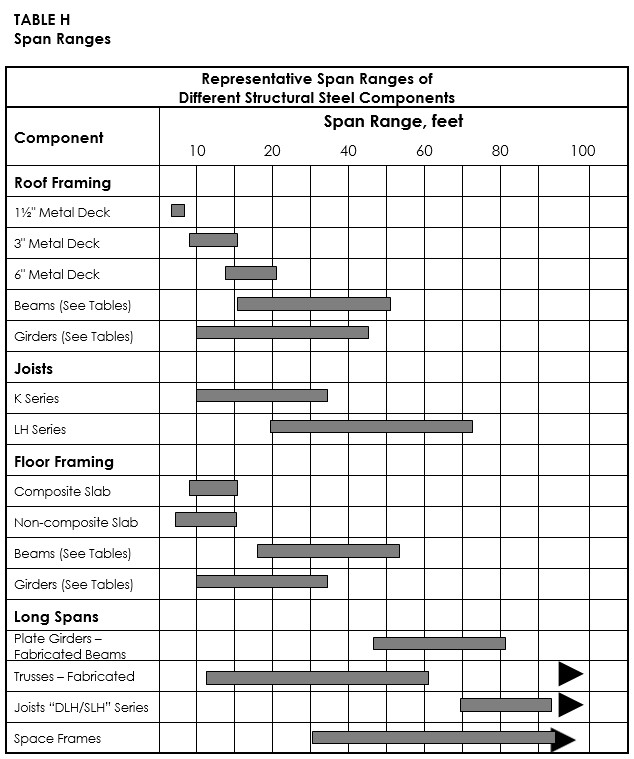
During schematic design, is there a span range I can start with for column bay spacing
ANSWER
AISC's Guide to Using the Preliminary Beam, Girder and Column Size Tables is a good place to start.
During the early stages of a project, before a structural engineer is engaged, architects frequently need to get a sense of the required column sizes and beam/girder depths that might ultimately be required for their projects. While this tool is not a substitute for structural engineering services, AISC has developed a series of tables to aid the architect in determining approximate column sizes and floor and roof system depths (Table sets A, B, C, D, E, F, G, H, I, J, and K).
Each set of tables represents a distinct set of floor and roof system parameters. Three different “live load” (example: people and non-permanent load) conditions for each range of beam and girder spans have been presented. The tables present nominal member depth ranges (example: W24 beams have a nominal depth of 24") for beam spans of 15 feet to 45 feet, as well as girder spans from 15 feet to 45 feet. Preliminary beam and girder depths can quickly be determined from the tables for square and rectangular bay sizes ranging from 15'x15' to 45'x45'.
The beam and girder depths indicated in the tables represent a range of depths for a particular span. It must be brought to the user's attention that a shallower member depth generally results in an increase in member weight, and therefore increased cost. As a general guideline a 25 percent increase in member weight will occur with each size of depth reduction. For example, if the reported range is W18 – W24 there will be an approximate 25 percent increase in weight for a W21 member to meet the same design criteria as a W24. A W18 member will have an approximate 25 percent increase in weight if selected in place of a W21. Should a W18 member be selected in place of a W24, the minimum increase in member weight will be approximately 60 percent (1.25 x 1.25).
As with any design challenge there are many solutions. Each project will have a unique set of loading and serviceability (deflection and vibration) parameters. The design information and example have been prepared accurately and consistently with current structural design practice for multiple load cases. The information presented in this publication has been prepared in accordance with recognized engineering principles and is for general information only. While it is believed to be accurate, this information should not be used or relied upon without competent professional examination and verification of its accuracy, suitability, and applicability by a licensed professional engineer.
For more resources like this, visit the Architecture Center's Engineering Basics.
November 2025: Fire Loads
QUESTION
What is a fire load and where do fire loads primarily come from in buildings?
ANSWER
Fire loads account for all combustible building contents including furnishings, equipment, as well as combustible construction components. Normally, most of the fire load in a building results from contents that have been introduced after the construction is complete. The fire load is usually expressed in terms of the so-called "wood-equivalent" weight of combustible building contents per unit building floor area (e.g., in psf). The actual weight of combustible contents is adjusted to the wood-equivalent weight based on the estimated potential heat of contents normalized to the potential heat of wood (8000 Btu/lb). Alternatively, the fire load could be expressed in terms of the potential heat of building contents per unit building floor area (e.g., Btu/ft2).

October 2025: Historic, Obsolete, or Discontinued Steel Shapes
QUESTION
I am developing an as-built analysis model and have come across a wide-flange beam size I cannot find in the 16th Edition Steel Construction Manual tables. Is it obsolete?
ANSWER
It is likely that you have come across an obsolete shape size. Consider the following questions:
- When was the building constructed?
- Are the flanges of the shape tapered? (perhaps it is an S-shape)
- If you field-measured the beam, what is your confidence in the accuracy of your measurements?
The answers to these questions may help you narrow your search. Section properties for historic, obsolete, or discontinued shapes can be found in one of three main places:
Historic AISC Manuals (available free to AISC members): An old Manual from the time period of the structure may include the properties for the shape. Historic manuals are available at aisc.org/oldmanuals.
AISC Design Guide 15: Rehabilitation and Retrofit: Chapter 5 of Design Guide 15 includes reference data (cross-sectional dimensions and properties) for steel shapes (wide-flange or I-shaped cross sections) that have been discontinued from 1887 to the present day. Similar data are included for wrought iron cross sections, which were phased out around 1900. This data is also contained in an Excel version in our historic shapes database, which can be downloaded for free at aisc.org/shapesdatabase.
Historic Shape References: Historic shape references are the shape catalogs of the various producers at the time. Many historic references can be found at aisc.org/oldshapes.
Be cautious with field measurements. For many reasons (such as presence of corrosion, the accuracy of the measuring instruments, and physical access to the section), measurements taken in the field may vary dramatically. Shapes have dimensional tolerances, so the section dimensions are inherently allowed to vary a bit during manufacturing. All of that to say it is unlikely one will find a perfect match for all the section properties. It is usually best to pick a section property or two that can be measured confidently, say the depth and flange width, and then find a section that best matches those measurements to start.
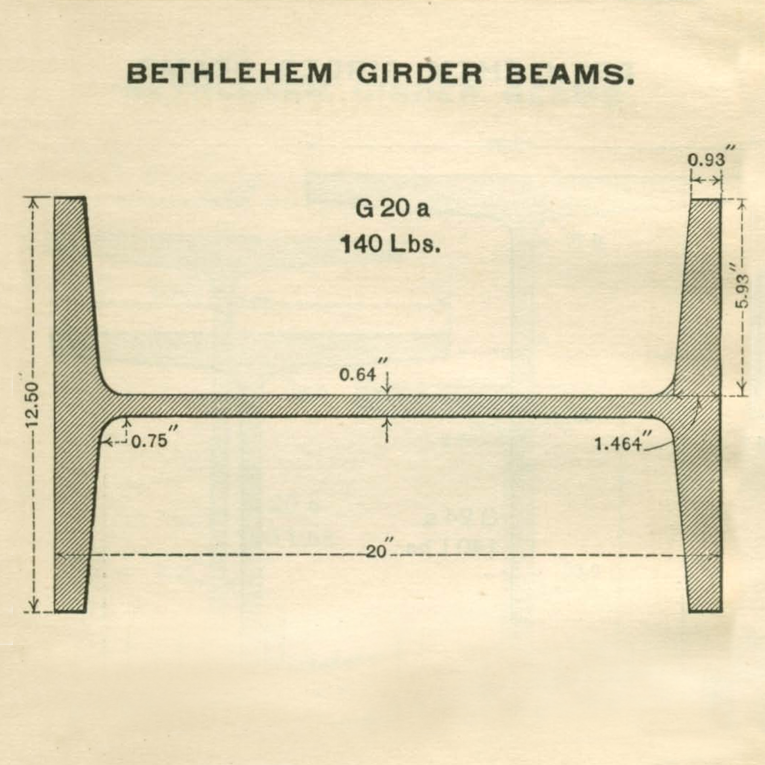
From the 1911 Catalogue of Bethlehem Structural Shapes (aisc.org/oldshapes).
September 2025: Fire-resistant steel
QUESTION
What does "fire resistant" mean, how is it different from "fireproof," and is steel considered a fire-resistant material?
ANSWER
Are you using the right term? Fire resistance means the ability of building components and systems to perform their intended fire-separating and/or load-bearing functions under fire exposure.
Fire-resistant building components and systems are those with specified fire resistance ratings based on fire resistance tests. These ratings, expressed in minutes and hours, describe the time duration for which a given building component or system maintains specific functions while exposed to a specific simulated fire event. Various test protocols describe the procedures to evaluate the performance of doors, windows, walls, floors, beams, columns, etc.
The term "fireproof" is a misnomer in that nothing is fireproof. All construction materials, components, and systems have limits and will, at some point, be irreparably damaged by fire.
Fire resistance ratings are assigned to construction components and systems, not materials. With relevance to fire, materials are classified for their combustion properties, and steel is non-combustible. Steel also has many other valuable structural and durability properties. Steel is used in many fire-resistant building components and systems where load-bearing structural steel members are usually coated, wrapped, or otherwise insulated/protected from the thermal effects caused by fire.
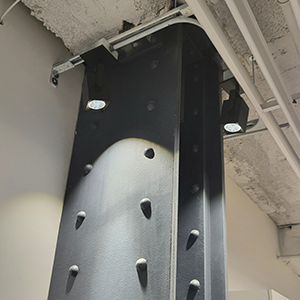
AISC's Chicago headquarters features exposed 70-year-old steel columns protected with fire-resistant intumescent paint.
August 2025: The reality of modern steel mills
QUESTION
Are modern steel mills the same smoke-belching behemoths that you've seen in old
movies?
ANSWER
Nope. There's a reason that mental image looks like a black-and-white movie.
People driving by American steel mills are often surprised that these factories are making steel. There are no billowing smoke stacks, and the only difference between a steel mill and an Amazon distribution center is the piles of steel beams waiting to be loaded on trucks. That's because modern mills use electric arc furnaces to melt scrap (today's structural steel contains on average 92% recycled content!) as part of a circular steel economy that makes structural steel one of the most sustainable building materials in the world.
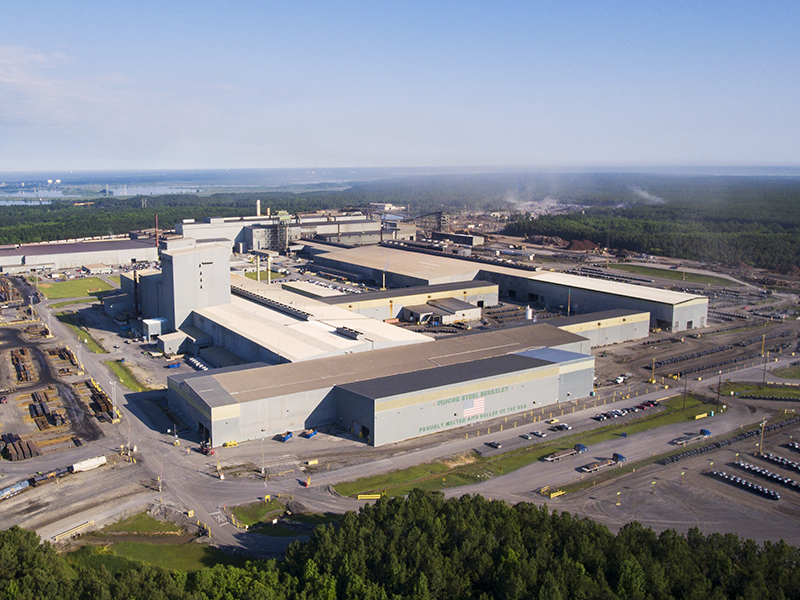
A modern structural steel production facility in operation in South Carolina
July 2025: Automobile crumple zones and steel-framed buildings
Question
Seismic design for structural steel buildings has been compared to designing crumple zones in automobiles. How so?
Answer
Both are designed to prioritize occupants' safety over the structure they're in.
The ductility of steel--the ability of steel to deform without breaking or rupturing--allows designers to build in "fuses" at specific locations that control the maximum force on critical elements, leading to safe, economical designs.
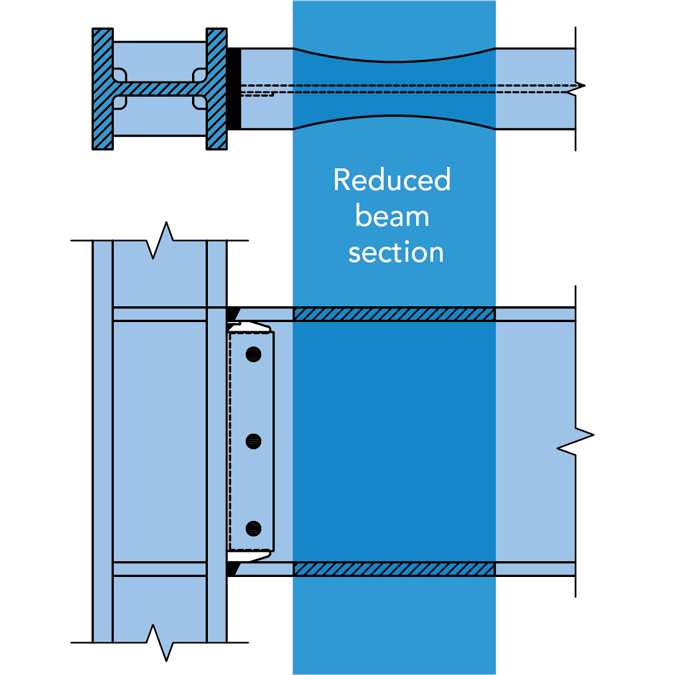
When designing for seismic events, the primary goal is to avoid partial or total collapse of the structure, which could lead to a large-scale loss of life. The ductility of steel is also effective in designing structures for functional recovery--the ability of a building to absorb an impact from a natural hazard, such as a seismic event, and remain operable or be quickly repaired and put back into service.
Whether moment frames or braced frames are used in a structure, there may be damage in certain parts of the structural steel frame in a high-seismic event. The objective is to confine the impact to specific parts of the frame to protect other parts of the frame--similar to a fuse. This behavior allows for more safety during an earthquake as it helps control where the damage occurs so that the integrity of the overall structure is maintained.
So where are the 'crumple zones' in buildings?
Moment frame
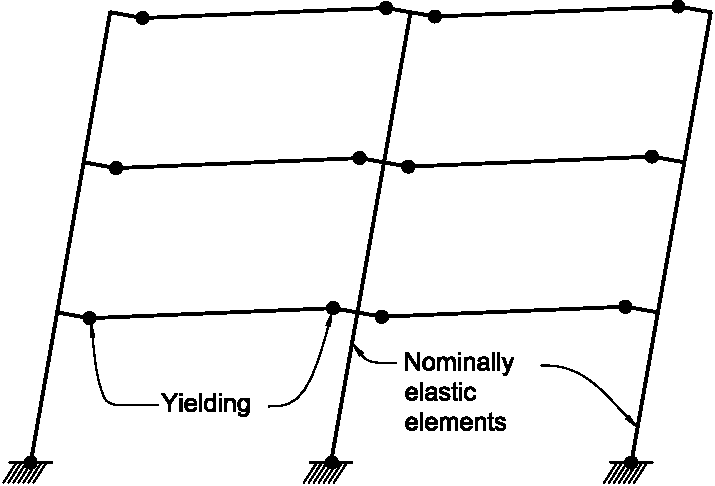
The image above is a basic view of how a moment frame would be expected to behave during a large earthquake. The damage to the steel frame would be concentrated at the points shown, indicating where the steel beams will yield.
Braced frame
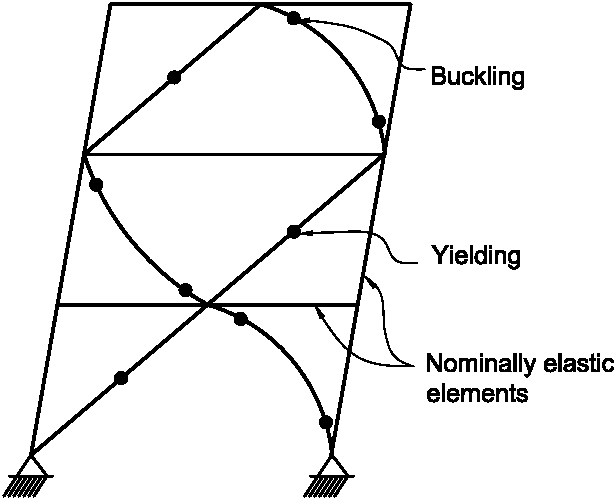
Braced frames behave similarly to moment frames during a large earthquake. The braces in this system act as a fuse, protecting the columns from becoming overstressed and failing.
June 2025: Size matters--comparing equivalent steel and wood columns
QUESTION
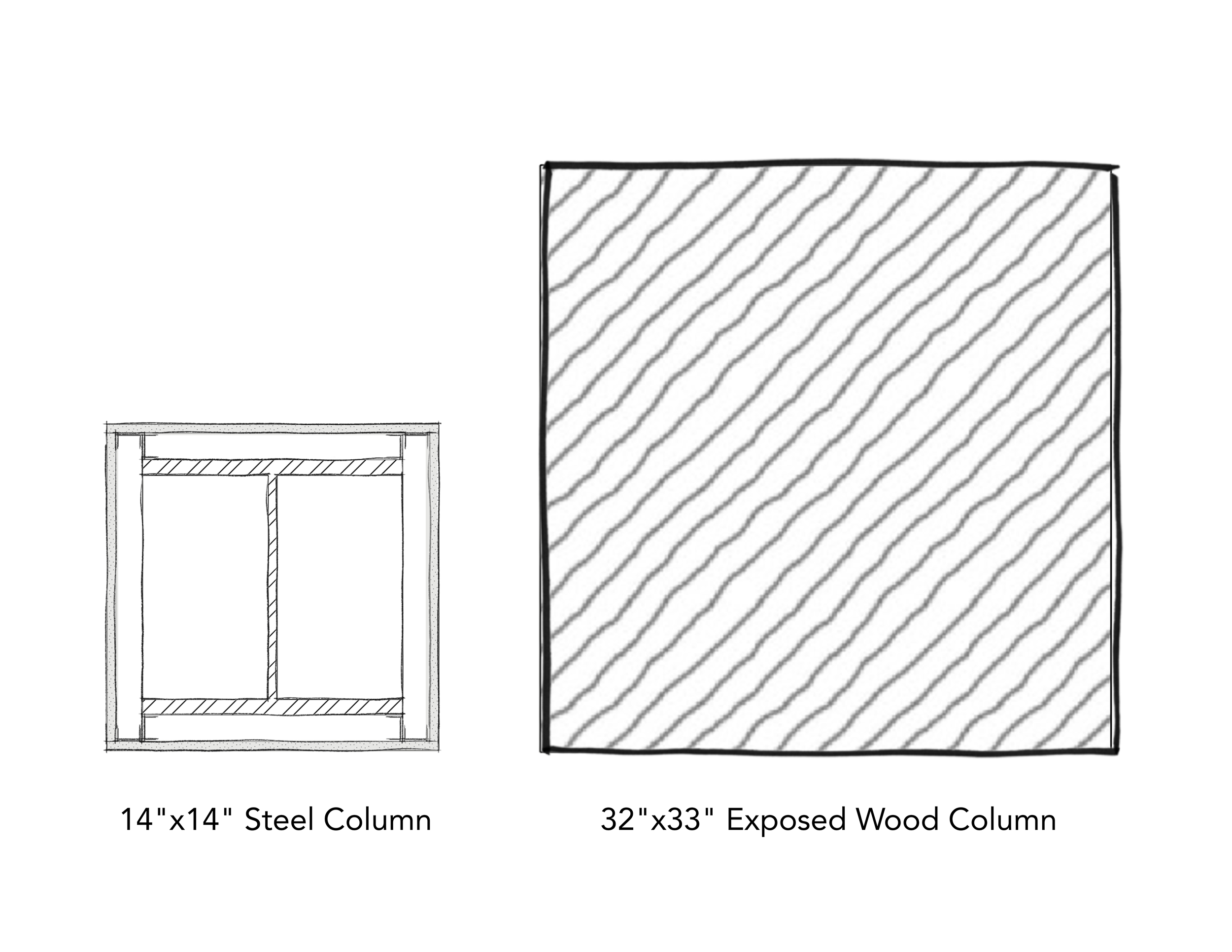
A steel column at the first floor of a 10-story multifamily residential building occupies a 14”x14” space. How much space would a comparable wood glulam column occupy?
ANSWER
32”x33”
Fire protection requirements largely drive the roughly 440% increase in the required column area in a recent comparison study by Simpson Gumpertz & Heger (SGH). Glulam columns are typically larger in cross section than an equivalent steel section, thanks to fire and strength requirements, and consequently using steel columns will yield more usable floor area. Applying an intumescent fire protection coating to a steel column may meet fire protection requirements without occupying any additional floor space. (Refer to AISC Design Guide 37, Hybrid Steel Frames with Wood Floors for additional information; it's a free download.)
May 2025: Easy-to-use dimensioning tool
Question
How do I know the exact dimensions of structural steel sections, such as a W12x26, so I can accurately illustrate my architectural drawings?
Answer
AISC offers a free and easy-to-use Structural Steel Dimensioning Tool that provides accurate dimensions for all rolled structural steel shapes readily available in the U.S.
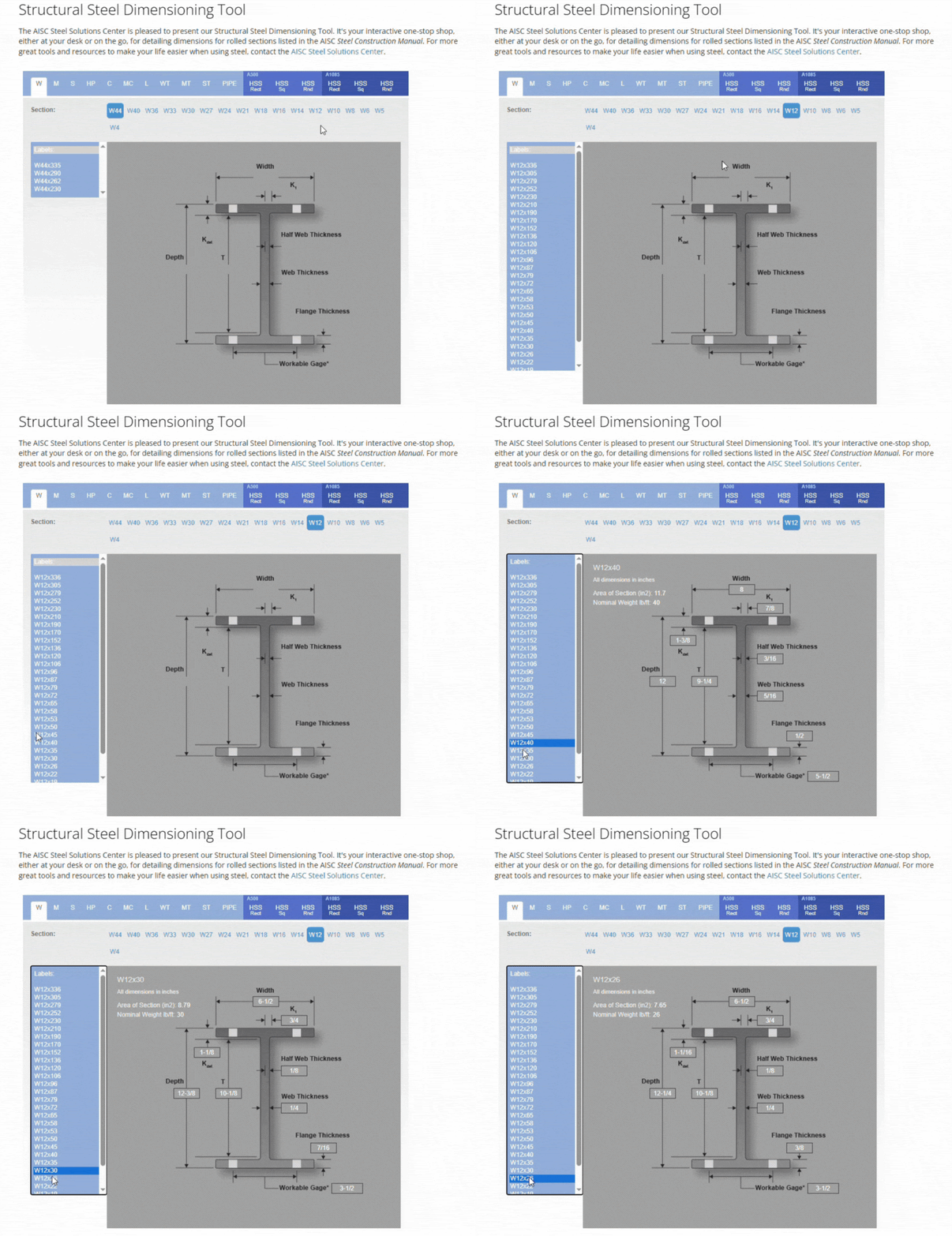
The designation of a standard wide-flange structural steel section, such as a W12x26, indicates the following:
- W: Indicates a wide-flange beam.
- 12: The nominal depth of the beam, measured from the top of one flange to the bottom of the other flange, is 12 inches.
- 26: The weight of the beam is 26 pounds per foot.
However, by using the dimensioning tool, you can easily determine that the actual depth is 12.25 in. and the width of the member is 6.5 in.
The tool enables architects to quickly find any specified rolled section size, enabling you to see its dimensions and be sure you have the correct member size illustrated in your drawing. The tool is especially helpful when designing in tight spaces and coordinating MEP/FP systems around structural framing. It provides accurate dimensions so you can size members accurately, avoid clashes with other trades, and reduce RFIs during construction.
Try the dimensioning tool and tell us about your experience at [email protected].
April 2025: Hybrid Steel Systems for Eccentric Facades
Question
How does a hybrid steel system accommodate an eccentric facade condition?
Response
A benefit to hybrid steel buildings is that any additional façade framing can be easily accommodated in the steel framing. Additionally, connecting directly to the steel framing avoids creep and moisture movement issues. Steel framing is often provided at the perimeter of the building due to the stricter deflection requirements at the façade. The perimeter steel framing can often be utilized to greatly simplify the façade connection interface of the building.
The simplest way to support the façade is generally to utilize the perimeter steel framing in lieu of the timber panels. Detailing façade systems attachments to mass-timber panels can be difficult, particularly in the weak direction of mass-timber panels or where eccentricities and moments are present.
AISC Design Guide 22: Façade Attachments to Steel-Framed Buildings (Parker, 2008), is a good reference to address façade and steel framing details. The examples and principles in this Design Guide still largely apply to hybrid steel and mass-timber floor panel projects.
Additional perimeter steel framing members can also be added where required for façade support. Steel framing provides great flexibility and simplicity in accommodating virtually any façade condition. Figures 6-24 shows an example of an eccentric façade condition that was easily accommodated with supplemental steel façade framing.
Steel-framed buildings can also easily accommodate thermal breaks to maintain a good thermal building envelope, which is often required by newer energy codes. Thermal breaks need to be detailed to allow for CLT panel installation.
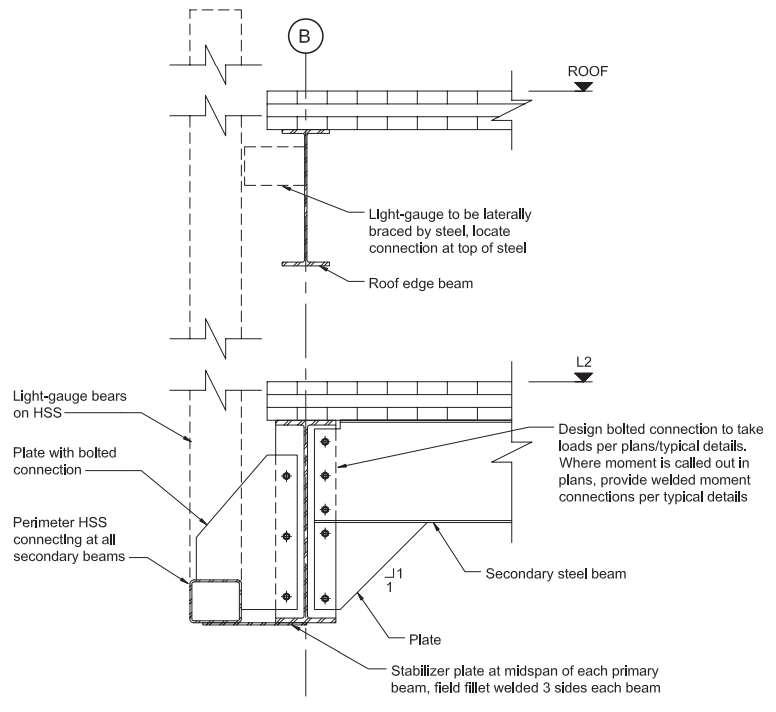
Fig. 6-24: Example of eccentric facade with perimeter HSS tube for facade bearing at Houston Endowment Headquarters.
Houston Endowment Headquarters. Kevin Daly Architects

March 2025: Occupant-Induced Floor Vibrations
Question
Are occupant-induced floor vibrations more perceptible in a steel-framed building than a building framed in other materials (concrete, wood)?
Response
No. Vibration has been studied and AISC provides accurate methods to help designers properly design a steel-framed floor to minimize perceptible vibrations.
According to ANSI/AISC 360-22 Specification for Structural Steel Buildings, Section L4: The effect of vibration on the comfort of the occupants and the function of the structure shall be considered. The sources of vibration to be considered include occupant loading, vibrating machinery, and others identified for the structure.
Where sound and noise control are tied to floor and wall assemblies and not the structural steel frame itself, the structural steel plays a much bigger part in controlling floor vibrations. As a result, AISC’s Design Specification for Structural Steel--used by structural engineers when designing structural steel buildings–includes a requirement that the effects of floor vibration be considered in the design.
AISC has developed resources to help designers evaluate their structures for vibration. When a designer checks a steel structure for vibration, they’ll be referring to AISC Design Guide 11. This design guide provides state-of-the-art design methods to ensure that vibration has been properly accounted for.
A database of 105 floor bays, 76 with complaints of lively vibration and 29 without complaints, has been studied by the authors of AISC Design Guide 11. The AISC Design Guide 11 evaluation criterion correctly predicted unsatisfactory evaluations for 74 of the 76 bays with complaints (97.4% accurate predictions). It correctly predicted satisfactory evaluations for 28 of the 29 bays without complaints (96.6% accurate predictions). If engineers are using the guidance provided in our design guide, there shouldn’t be any vibration concerns.
Quick tips for architects to consider with respect to vibration
According to AISC’s Facts for Steel Buildings - Number 5 – Vibration (Section 2.8, page 4):
-
In open-area office layouts, long walking paths and walking paths perpendicular to the beam or joist span at mid-bay should be avoided. While deeper members may be required, other ways exist to mitigate occupant-induced vibrations.
- For floors supporting rhythmic activity, floor natural frequency is the most important parameter. To achieve a specific frequency, the required total load deflection magnitude is the same regardless of span. For long-span floors, while deeper members may be required, other ways exist to mitigate floor vibration.
- Computer monitors or other items supported on relatively flexible arms may jiggle, causing user complaints, although these vibrations may not be associated with floor motion.
- Vibration is usually maximal near the center of the bay, so locating sensitive equipment as close as possible to girders or columns should be considered.
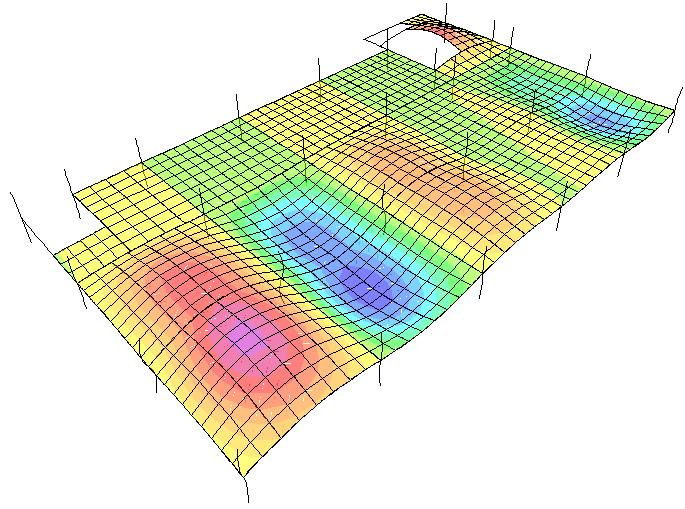
Example of predicted vibration mode shape for floor framing. In this model, warm colors indicate upward deflections and cool colors indicate downward deflections.
February 2025: Costs and Procurement Time for Green Steel
Question
Will using green steel make my project more expensive and take longer to procure?
Answer
No. In fact, if your project uses wide-flange members, your budget and schedule are already based on green steel.
The term “green steel” typically refers to steel produced from recycled ferrous scrap rather than mined iron ore, coke, and limestone. Electric arc furnaces (EAF) use recycled steel scrap, instead of iron ore and coke, to make new steel beams and columns. In the U.S., all hot-rolled steel members are produced in sustainable electric arc furnaces using electricity as the primary energy source.
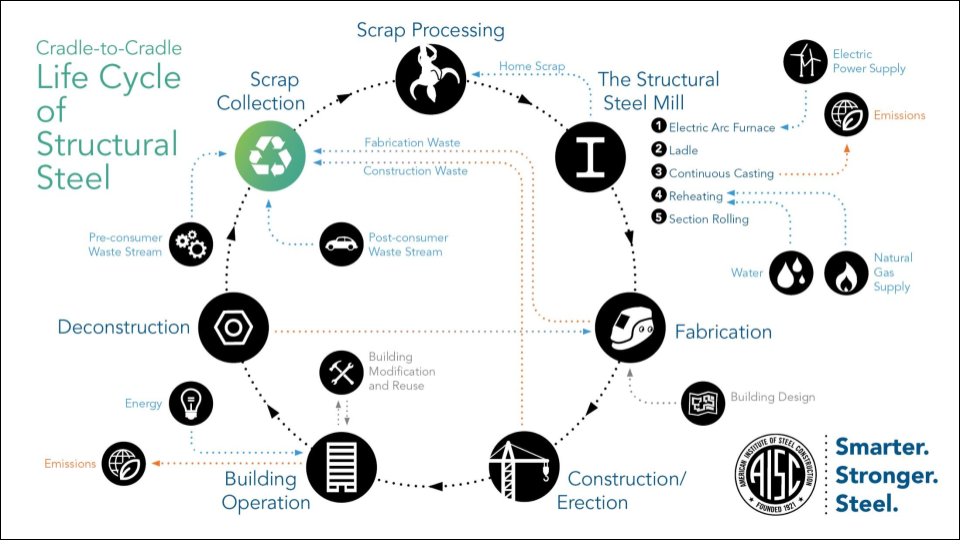
Using scrap metal as its primary source component, the steel-making process continuously recycles steel into new structural steel products – a sustainable cradle-to-cradle life cycle.
So even if you aren’t specifically specifying green steel, as long as you’re using domestically produced steel, you’re going to get it! In fact, the average new steel member from a domestic mill contains an average 93% recycled material. And steel can be recycled over and over again with no loss of properties.
However, structural steel produced outside the U.S. still often comes from old mills that use iron ore, coke, and limestone. In addition, not all EAF mills are the same. In fact, a typical Chinese mill results in around twice the global warming potential per ton of steel as a domestic mill. That’s why we recommend always specifying domestically produced structural steel.
Choosing green steel doesn’t involve any compromises. Steel construction products made from green steel meet the same metallurgical and performance standards as products from traditional production methods, and they have the same prices and typical schedules, as well.
In addition to keeping building materials out of landfills, green steel’s global warming potential is one-quarter to one-third that of traditional production methods.
More on the sustainability of structural steel, including a Sustainability Designer Toolkit, can be found at aisc.org/sustainability.
January 2025: Priming or Painting Enclosed Steel
Question
Does structural steel need to be primed or painted if it is enclosed or covered? Is corrosion a concern if the steel is not primed or painted?
Response
No, corrosion is not typically a concern with enclosed steel and there is usually no need to prime or paint steel that is enclosed or covered. Painting steel unnecessarily results in increased costs while also producing a negative environmental impact.
AISC’s longstanding recommendation is that in building structures, steel need not be primed or painted if it will be enclosed by building finish, coated with a contact-type fireproofing, or covered with concrete.
As stated in section M3.1 of the AISC Specification for Structural Steel Buildings (1993, 1999, 2005, 2010, 2016, and 2022): “Shop paint is not required unless specified by the contract documents.” The commentary then elaborates that: “The surface condition of unpainted steel framing of long-standing buildings that have been demolished has been found to be unchanged from the time of its erection, except at isolated spots where leakage may have occurred. Even in the presence of leakage, the shop coat is of minor influence (Bigos et al., 1954).”
In addition, priming or painting can have a negative effect on performance when the steel is going to be fireproofed (either by the application of a spray-applied cementitious coating or intumescent coatings) because the primer can decrease the adhesion of the fire-protective material.
There are two exceptions to the advice not to prime or paint steel in enclosed structures: corrosion protection should be specified when the critical relative humidity level is expected to be above 70% as well as in industrial structures where corroding chemicals are present.
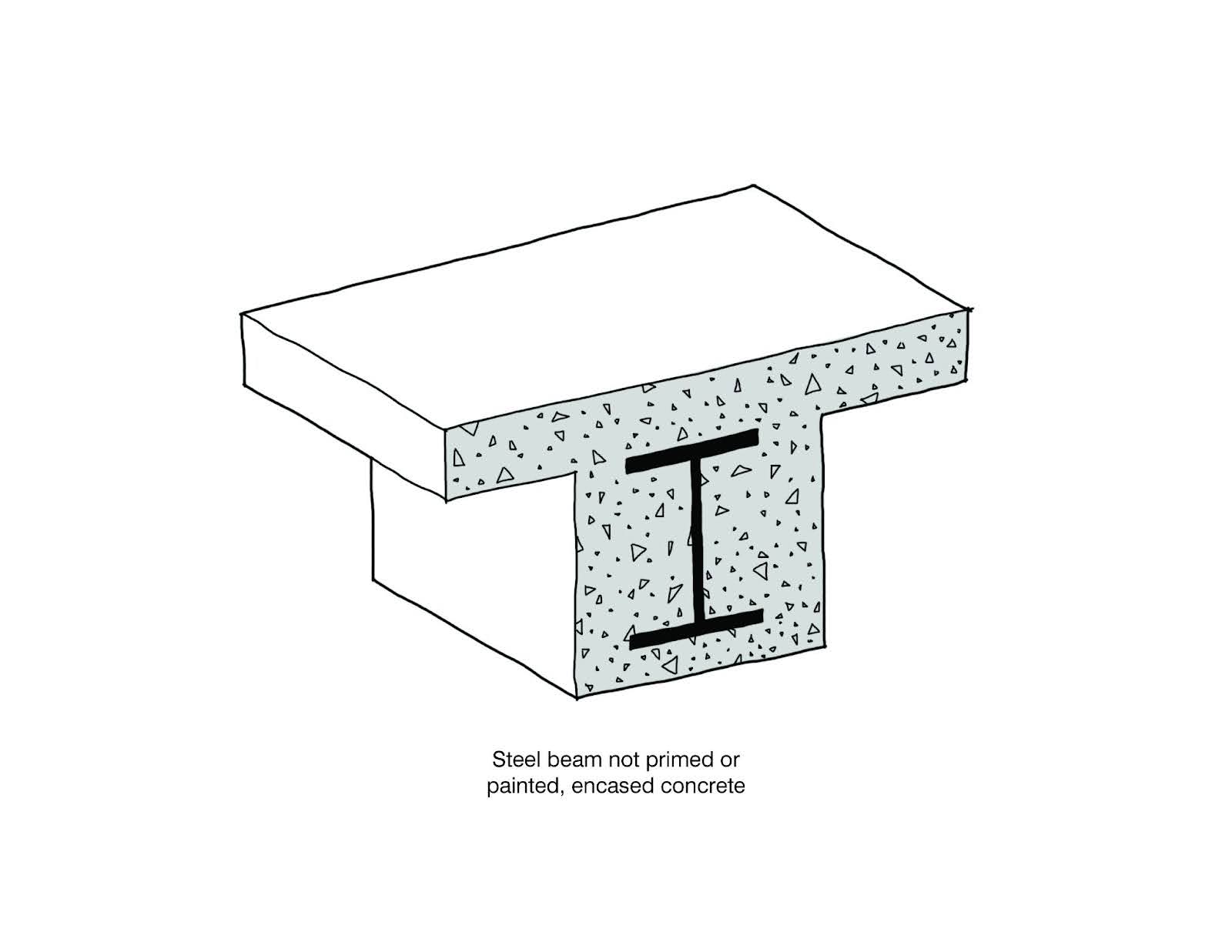
Sketch by AISC Architecture Center
December 2024: Curving Structural Steel into Tight Radii
Question
Can structural steel be curved into very tight radii, such as corkscrew or helical shapes?
And if so, do you have to heat it to be able to curve it?
Response
(Supplied by Chicago Metal Rolled Products):
Question 1: Yes, steel can be curved into very tight radii.
Question 2: No, you don’t always have to heat the steel to bend or curve it.
There are many machines available today to assist in bending or rolling steel, from thin sheet metal and flat bars to large beams and tubes. By applying enough pressure—and sometimes heat—most metals can be bent relatively easily. However, the quality of a bend is influenced by many variables, and it is crucial to consider the end use of the material to determine the most suitable bending or rolling method for the desired outcome.
It’s often assumed that very tight radii require heat bending, but this is not always the case. The appropriate method depends on the customer’s needs and project goals. For example, if the steel member will be covered, there is often more flexibility regarding cosmetic distortion. However, if the steel member remains exposed as a focal point, the bender-roller team selects the bending method that will minimize or control distortion as much as possible. In some cases, this may involve induction bending or heat bending.
Advancements in induction bending technology have revolutionized the bending process. For specific applications of bent and curved steel, induction bending is often preferred—or even required—over cold forming methods. Cold forming can lead to issues such as wall thinning, rippling, and ovality in pipes and tubes due to the pressure applied by steel dies during the process. Induction bending mitigates these issues by using a unique process that, while more time-consuming, allows for tighter radius bends with minimal distortion. This capability is especially critical for large tubes and pipes requiring precise bends.
Regardless of the method, involving the bender-roller at the early design stage is essential for a smooth and successful project. This proactive approach facilitates better planning, reduces potential issues, and ensures higher-quality results and greater customer satisfaction.

Courtesy of Chicago Metal Rolled Products
This CAD drawing illustrates the capabilities of a bender-roller when rolling rectangular tubes helically to a tight radius.
November 2024: Fire Protection for HSS Columns and Beams
The AISC Steel Solutions Center has an FAQ to address fire protection of HSS. Here's an excerpt of that FAQ.
Question
We have a steel medical office building with several stairs and elevator shaft wall corners framed with hollow structural section (HSS) columns. We’ve been informed that a one-hour fire rating is required for these HSS columns and beams framing into them. Can you provide more insight into protecting HSS against fire?
Response
When it comes to protecting HSS against fire, three options exist: coat it, cover it, or fill it.
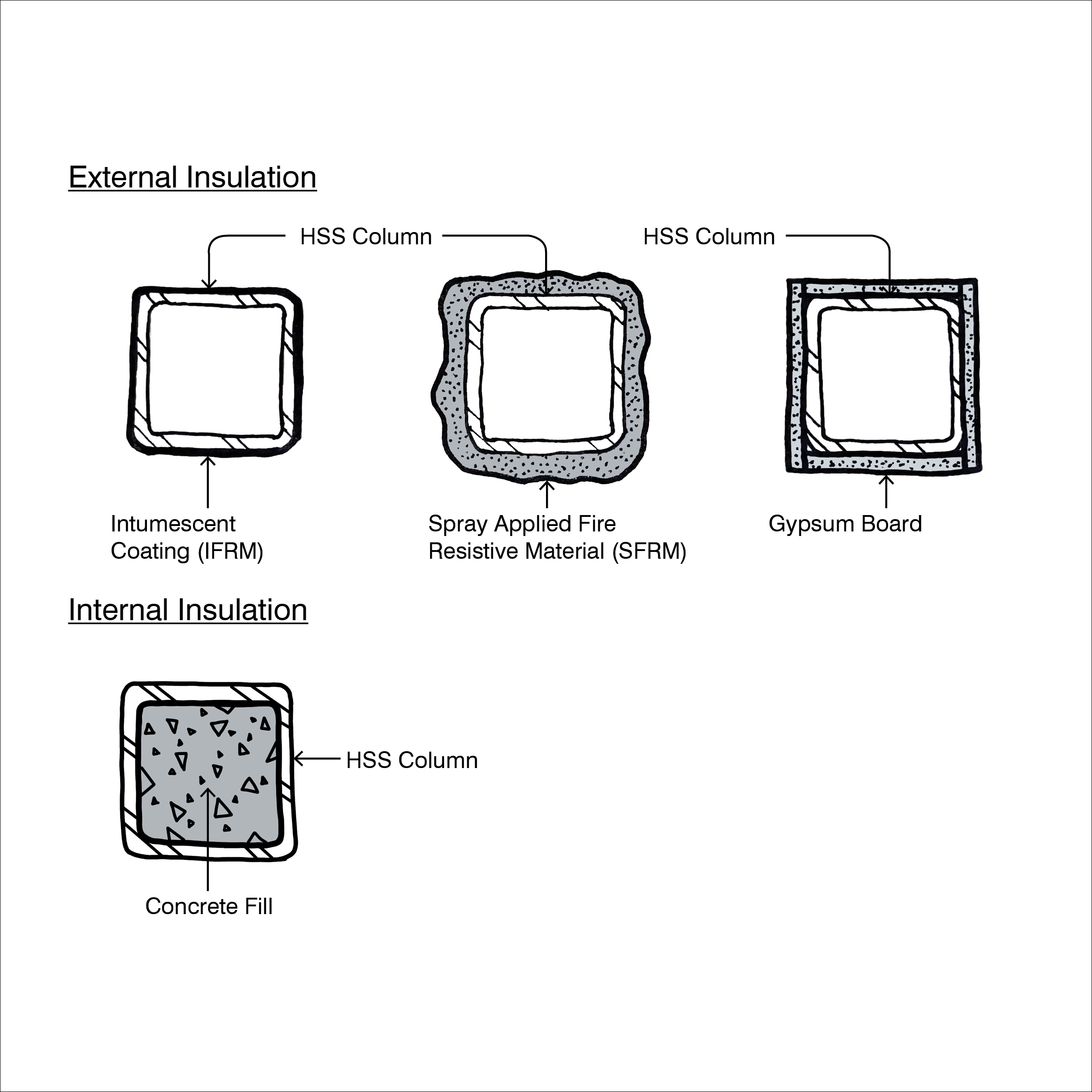
Sketch by AISC Architecture Center
Coat It
Intumescent Coatings
Intumescent coatings are paint-like mixtures applied to the primed steel surface. When subjected to high heat, these coatings expand to many times their original thickness, forming an insulating blanket that protects the steel member from heat. These coatings allow for fire ratings of up to four hours.
Intumescent coatings provide many benefits, including reduced weight per surface area protected, durability, aesthetic appeal, and good adhesion. Aesthetics is typically the main driver for selecting this system--steel members protected with intumescent coatings are often used in architecturally exposed structural steel (AESS) applications and can be colored if desired. New intumescent paint products can be applied off-site to save on-site construction time. Maintenance of intumescent systems--cleaning the protected members and post-installation repairs--is relatively easy.
With these advantages sometimes comes a higher cost compared to other fire protection systems, particularly for higher fire ratings. One way to control that cost is to upsize the steel and thus decrease the required thickness of the intumescent coating. This not only reduces intumescent material costs but also decreases the labor and drying times involved with the application process. Additionally, there should be enough room around the steel member for the intumescent paint to expand, should a fire make that necessary.
Spray-Applied, Fire-Resistant Materials (SFRMs)
Spray-applied, fire-resistant materials (SFRMs) insulate the structural steel from rapidly rising temperatures and are typically used if steel is hidden from view, such as above a ceiling or behind drywall.
The biggest advantages of using SFRM are speed, efficiency, and cost-effectiveness. SFRMs are field-applied, and surface preparation time is minimal, only requiring the removal of dirt, oil, grease, and loose mill scale. The application of SFRM is relatively easy and fast; however, because it is a wet process, it can impact other trades. Protecting on-site areas from overspray is typically required.
Research has shown that it is unnecessary to paint structural steel when it is protected with spray-applied fire protection materials or fully enclosed between the inside and outside walls of a building.
Cover It
Gypsum is commonly used for fire protection, and it comes in a variety of formats. Adding lightweight mineral aggregates such as vermiculite and perlite can significantly increase the effectiveness of gypsum-based fire protection systems.
Gypsum board can be installed over steel framing or furring and comes in a few different varieties. Type X wallboards have specially formulated cores that provide greater fire resistance than regular wallboards of the same thickness. Gypsum board enclosures are relatively cost-effective when compared with other fire-resistant products. Gypsum board walls and ceilings are commonly used in building projects for interior finishes; thus, upgrading to a fire-resistive gypsum assembly achieves two goals simultaneously--interior finish and fire protection.
Fill It
Round, rectangular, and square hollow structural sections (HSS) and pipe can be filled with concrete to increase their fire resistance. The HSS serves as permanent formwork for the concrete, which can be reinforced by standard bars, or by adding steel fibers to the wet concrete mix. The HSS can be filled off-site or erected and filled on-site.
During a fire, heat passes through the steel to the concrete, which serves as a heat sink. As the yield strength of the steel decreases, the load is transferred to the concrete. The steel encasement and reinforcement help limit the heat effects on the concrete, such as spalling and strength degradation. Ventilation holes in the steel encasement allow for steam to be released when the concrete is heated, relieving pressure.
This method is frequently used in exposed steel applications because the steel can be easily painted.